Three-Tab Vs Architectural Shingles At A Glance
The three-tab vs architectural shingles question comes up on nearly every replacement we quote in Central Texas. Most of the roofs we tear off are original three-tab, flat and thin, with granules worn down to the mat on the south-facing slopes, and most of the roofs we install in their place are architectural. Estate Roofing Solutions installs both, and the right choice depends on your budget, how long you plan to own the house, and how much weather your neighborhood sees.
Here is how the two compare on the points that matter most to a Central Texas homeowner.
| Feature | Three-Tab | Architectural |
|---|---|---|
| Cost | Lower material cost | Moderately higher material cost |
| Typical lifespan | Often 15 to 20 years | Often 25 to 30 years |
| Wind resistance | Commonly rated around 60 mph | Commonly rated 110 mph and higher |
| Warranty | Shorter material warranty | Longer material warranty, often lifetime limited on premium lines |
| Weight | Lighter per square | Heavier per square |
| Appearance | Flat, uniform tabs | Layered, dimensional look with deeper shadow lines |
What Three-Tab Shingles Are
Three-tab shingles are a single flat layer cut into three even tabs per strip, with a uniform thickness and a uniform shadow line. They were the standard roofing product for decades, and plenty of them are still doing an adequate job on houses across Pflugerville and Round Rock. Their lower cost and lighter weight make them a reasonable fit for a detached garage, a shed roof, or a rental property where coverage on a tight budget is the goal.
What Architectural Shingles Are
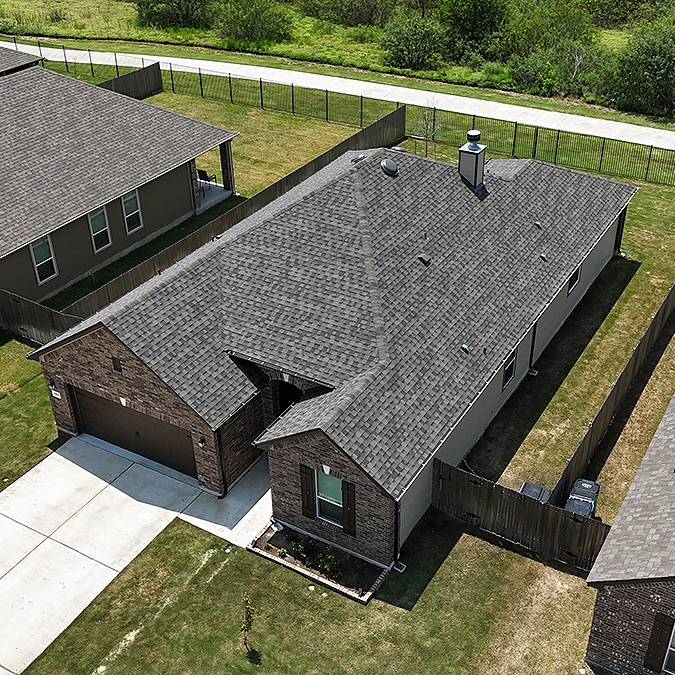
Architectural shingles, sometimes called dimensional shingles, are built from laminated layers. The extra layer gives them a heavier profile, a shadow line with real depth, and more mass per square than a three-tab product.
That mass pays off on the roof. A heavier, laminated shingle sits flatter against the deck, resists lifting at the edges, and gives a house the finished look most homeowners picture when they imagine a new roof. It is the product we install most often on a full roof replacement.
How Much More Do Architectural Shingles Cost?
The material gap between the two is smaller than most homeowners expect, because shingles are one line in a bigger job. Labor, underlayment, flashing, ventilation, and tear-off make up most of a replacement, and those lines stay the same whichever shingle goes on top. Our breakdown of what affects the price of a roof replacement in Central Texas walks through each of those lines, and it shows why the upgrade to architectural usually adds a modest share to the total.
Lifespan In Central Texas Heat
Lifespan is where the two products separate most. Summers that push attic temperatures well past a hundred degrees dry out the asphalt in a thin shingle, and cracking and curling follow. Three-tab roofs here often reach the end of their service life well before the number printed on the wrapper.
Architectural shingles carry more asphalt and a second layer, so they ride through the same heat cycle for years longer. That means fewer seasons wondering whether a patch will hold. Our post on cheap vs quality shingles in Central Texas goes deeper on how product tier relates to long-term value.
Wind Rating, Granule Retention, And Weight
Wind is the everyday test for a Central Texas roof, and it is where laminated construction helps most. Architectural lines are commonly rated for 110 mph winds and higher when installed to the manufacturer’s nailing specification, while standard three-tab lines are commonly rated closer to 60 mph. A thicker mat also holds granules longer, and granules are the layer that shields the asphalt from UV.
Weight is the other half of that picture. Architectural shingles weigh more per square, which is a non-issue on most homes built to current code. On an older home, we inspect the decking at tear-off before any shingle goes on, and that step is the same whichever product you choose.
Hail And Class 4 Impact-Resistant Shingles
Standard architectural shingles are generally not impact-rated for hail. Class 4 impact-resistant shingles are a separate product line, tested against a 2-inch steel ball, and they are built with a more flexible mat and polymer-modified asphalt. In a hail-heavy area like Williamson County, a Class 4 product deserves a conversation, and some insurers recognize those roofs with a premium discount, so it is worth asking yours. Class 4 shingles carry a higher price than a standard architectural product, which makes the decision one of budget and local hail exposure.
Hail is one of several things that shorten a roof’s life, and our guide to how long a roof lasts in Central Texas covers the others.
Installation Details That Matter For Either Product
Both shingle types depend on the same fundamentals. Nails land in the manufacturer’s nail zone, starter strip seals the eaves and rakes, valleys get proper treatment, and flashing is cut to fit at every wall, chimney, and pipe. Architectural shingles have a laminated nailing area, so placement within that zone is part of what earns the published wind rating.
Many manufacturers also call for extra nails per shingle in high-wind installations, and we follow the specification printed on the wrapper for the product on your roof. Owens Corning, GAF, and Malarkey all make both product types, so the installation standard stays consistent whichever brand you choose.
Warranty Coverage By Product Tier
Manufacturer warranties follow the product tier. Three-tab lines usually carry shorter material coverage than architectural lines from the same maker, and premium architectural lines from GAF, Owens Corning, and Malarkey often carry the longest terms, which tracks the lifespan gap. The shingle warranty covers the material, while workmanship coverage from the installer covers the installation, so it is worth asking any contractor for the workmanship terms in writing.
Curb Appeal And Resale
Architectural shingles read as a heavier, more finished roof from the street, and buyers and inspectors notice the difference between a flat three-tab roof and a dimensional one even when they cannot say why. For a house you plan to hold for a decade or more, that look compounds in listing photos and next to newer construction going up in the same neighborhood. Finished examples of both are in our project gallery.
Which One Fits Your Roof
For a primary residence anywhere in our service area, architectural shingles are what we recommend to our own neighbors, and it is what most homeowners choose once the two products sit side by side.
Three-tab still has a place. A detached workshop with no living space beneath it, a rental you plan to sell within a year or two, or a strict HOA budget line can all be good reasons to choose it, and we will say so when it is the smarter call for your situation. A house that will be torn down or remodeled in a few years is another example, since a long shingle lifespan gives no return on a roof with a short future.
Our residential roofing process starts with a look at your roof, your pitch, and your timeline. Book an inspection and Estate Roofing Solutions will walk your roof, talk through what each shingle means for your budget, and recommend the one that fits. Schedule an inspection.